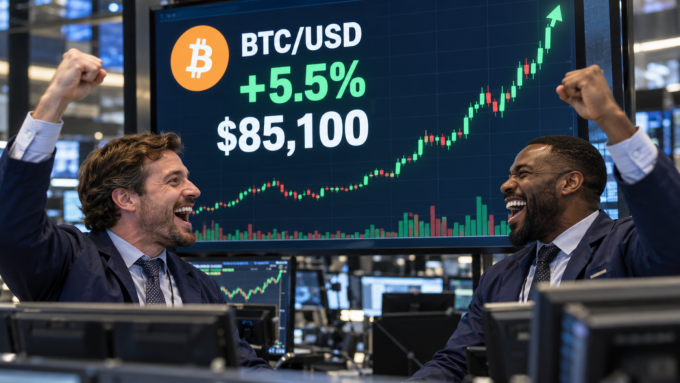


Bitcoin is rallying despite a macro backdrop that should, on paper, be working against it.
BTC has jumped from roughly $76,000 last week to around $86,000 this week, extending a sharp rebound even as the Fed raised interest rates, oil remained elevated, and the US-Iran conflict continued to cloud the outlook.
Yet the move is not happening in a vacuum.
US stocks have also recovered, oil has pulled back below $100, and Treasury yields have eased from recent highs as markets price in a better supply outlook and tentative diplomatic signals around Iran.
Still, Bitcoin’s scale of the rebound stands out.
“The short squeeze explains how fast Bitcoin moved, not why,” Bernardo Brites, co-founder and CEO of Trace Finance, told Invezz.
The squeeze explains the speed
There is little doubt that short covering has amplified Bitcoin’s gains.
As BTC pushed through key resistance levels, traders betting against the cryptocurrency were forced to buy back positions, creating another wave of demand at precisely the moment momentum was building.
More than $1 billion of crypto positions were liquidated over a 24-hour period during the latest surge, including the majority from short positions, according to CoinGlass data.
But short squeezes are self-limiting. Once the shorts are gone, that source of buying disappears.
The more important clue is therefore what happened alongside the squeeze.
US spot Bitcoin ETFs recorded $998.95 million in net inflows on September 21, their strongest single-day haul in 11 months.
The funds then attracted another $714.7 million on September 22, according to Farside Investors.
That matters because Bitcoin’s supply cannot expand quickly enough to absorb a sudden increase in demand.
“What is interesting about Bitcoin is that its supply does not respond to price in the way the supply of most commodities does,” Chris Seedor of bitsurance told Invezz.
“You cannot issue more Bitcoin because demand increased this week. So relatively modest changes in marginal demand can produce disproportionately large price movements, particularly when positioning is already leaning the other way.”
Flows turned positive on September 17 and September 18 before accelerating to nearly $1 billion on Monday.
That suggests fresh demand was returning, even as derivatives positioning amplified the move.
Pavel Efremov, director at institutional crypto OTC desk FinchTrade, says some of that demand may not be visible on public exchanges.
“The more interesting question is who kept buying once the shorts were out,” Efremov told Invezz.
“Part of institutional demand gets worked off public order books through OTC desks, so it can show up in price before it shows up in exchange volume.”
That leaves several possible sources of demand operating at once: ETF flows in public markets, institutional activity through OTC channels, and forced buying from short sellers.
Wall Street is buying; crypto may not be
That raises a more complicated question about the quality of the new demand.
The ETF numbers show that institutional capital is returning to Bitcoin through regulated investment products.
They do not necessarily show that liquidity is flooding back into the crypto ecosystem more broadly.
Brites points to a potential disconnect between the two.
“Nearly $1 billion went into US spot ETFs on Monday, yet stablecoin supply, the dollars crypto investors hold on-chain to buy with, hasn’t grown since May,” he said.
“The new capital is arriving through Wall Street, not through crypto markets directly. That makes this a narrower rally than the price suggests.”
Courtney Olujobi, principal at Moon Pursuit Capital, points to a related distortion in the headline number.
Many large investors buy Bitcoin while simultaneously hedging against a drop, meaning a meaningful share of reported inflows isn’t a directional bet at all.
If that distinction holds, the rally could be occurring without a comparable expansion in crypto-native liquidity.
Stablecoin activity can still rise without supply growing.
Brites said transaction volumes on his firm’s rails have continued to increase, even as stablecoin supply has plateaued.
“Higher turnover isn’t the same as new money coming in,” he said.
That distinction could matter for the rally’s durability.
If ETF demand remains strong, the flow of institutional capital could continue to support prices.
If those inflows fade, the market will have fewer obvious sources of fresh demand.
The macro backdrop is less hostile at the margin
There is also a temptation to portray Bitcoin as completely decoupled from macro conditions. The recent market action does not quite support that.
The Fed raised its benchmark interest rate by 25 basis points on September 16 to 3.75%-4%, with inflation still elevated.
But since then, oil prices have retreated. Brent fell below $100 this week as Saudi Arabia restored part of its disrupted pipeline capacity and Iran reportedly signaled a willingness to consider reopening the Strait of Hormuz under certain conditions.
At the same time, technology stocks have rallied, and the Nasdaq reached a record high on Tuesday, suggesting that risk appetite has improved rather than collapsed.
Seedor cautioned against reading too much into a few days of price action.
“I think people tend to over-explain Bitcoin’s short-term price movements,” Seedor added.
“Markets are clearing mechanisms, not machines that emit a neat causal explanation after every 5% move.”
He also noted that the rally has coincided with a broader recovery in risk assets, rather than occurring in complete isolation.
Institutions may be rebuilding positions
Another possibility is that the rally reflects a reversal in institutional positioning rather than a sudden flood of new money.
Nick Anderson, CMO and co-founder of Altcoin Pro, argues that some institutions may be rebuilding crypto exposure after reducing positions during the third quarter.
“What we’re seeing now is the opposite of that,” Anderson told Invezz.
“New money isn’t being injected into the market and buying. Instead, we’re seeing the rebalancing of portfolios that had gotten underweight crypto.”
If that positioning shift is taking place, it would give the rally a different foundation from a short squeeze alone.
Short covering is inherently limited once the positions are closed.
Portfolio rebalancing, by contrast, could continue after the initial squeeze if investors are rebuilding allocations.
Anderson also argues that some investors are treating Bitcoin as a form of portfolio insurance amid geopolitical tensions and elevated Treasury yields
Brites sees a similar possibility, saying some investors may be buying Bitcoin as a hedge against inflation, fiscal pressures and geopolitical risk rather than because they expect a return to ultra-easy monetary policy.
The real test starts now
The strongest argument against calling this a durable Bitcoin rally is also the simplest: some of the easiest buyers have already been forced into the market.
Short sellers who needed to cover have covered. The question now is whether discretionary buyers will replace them.
“The real test comes once the shorts have been cleared,” Brites said.
“If ETF demand holds and stablecoin supply starts growing again, the rally has a solid base. If ETFs remain the only engine, the move is vulnerable.”
Anderson sees two possible paths from here.
“If this is only a short squeeze + ETF flow story, then gains will evaporate once positioning normalizes, which is probably within 4-6 weeks,” he said.
“But, if institutional rebalancing and macro risk perception are the primary movers, this move has legs into the beginning of 2027.”
Olujobi is watching a narrower signal: whether the buying is real.
“I’d watch whether money keeps coming into the funds on days when the price drops, and whether buyers are paying for actual Bitcoin rather than borrowing to bet on it,” he told Invezz.
“If borrowed bets start driving the price again, this is more likely a short bounce than the start of something bigger.”
The post Is Bitcoin’s rally real or just a short squeeze? Analysts weigh in appeared first on Invezz